
It turns out that it’s not only modern travellers who dream of a front-row spot by the sea. More than 2,000 years ago, the Romans were already thinking the same — and the ruins of Baelo Claudia (Baelo Claudia) are living proof of it.
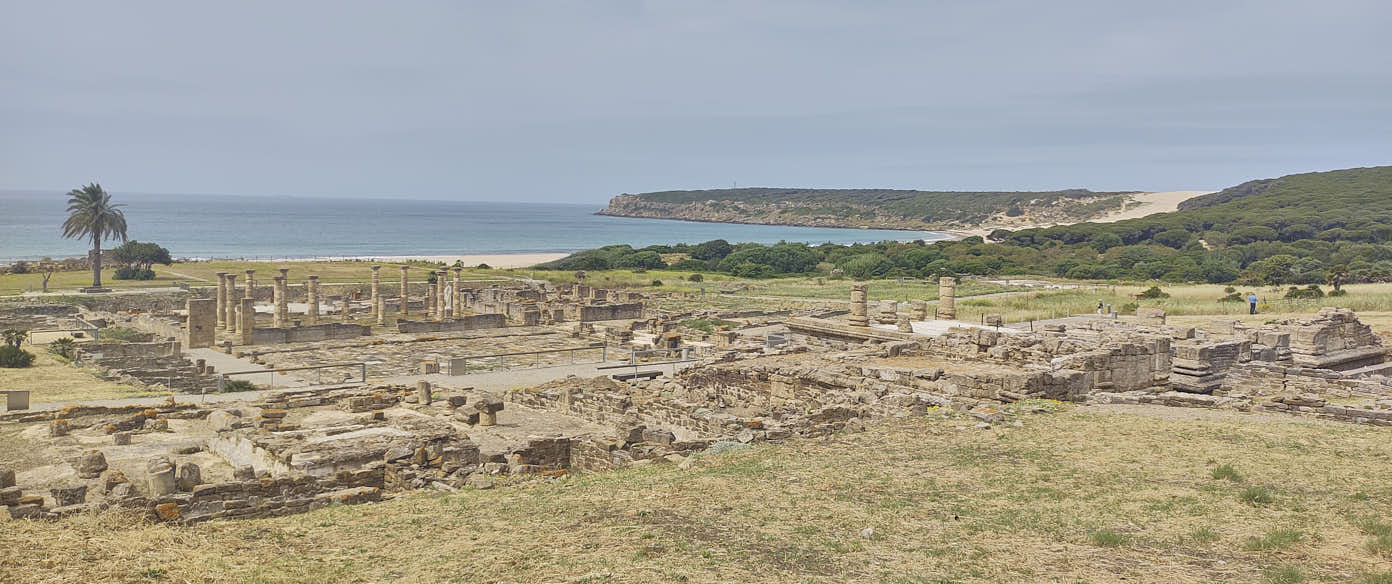
They built their city right on the Atlantic coast, in a privileged setting that, without the need for Booking or property portals, remains one of the most impressive cultural landscapes in southern Spain. Today, Baelo Claudia is one of the most important and best-preserved Roman archaeological sites in Andalusia, combining history, archaeology, and raw natural beauty in a single place.
Contents
We’ve visited Baelo Claudia several times over the years, and in this guide we share what makes it so special: what to see inside the archaeological complex, how to plan your visit, and why it’s such a unique place to experience Roman history in the open air.
Beyond the ruins themselves, the surroundings are extraordinary. Just behind the site rises the Bolonia dune, a natural monument over 30 metres high, while in front lies an unspoilt Atlantic beach with white sand and crystal-clear water — a setting that rivals far more distant destinations.
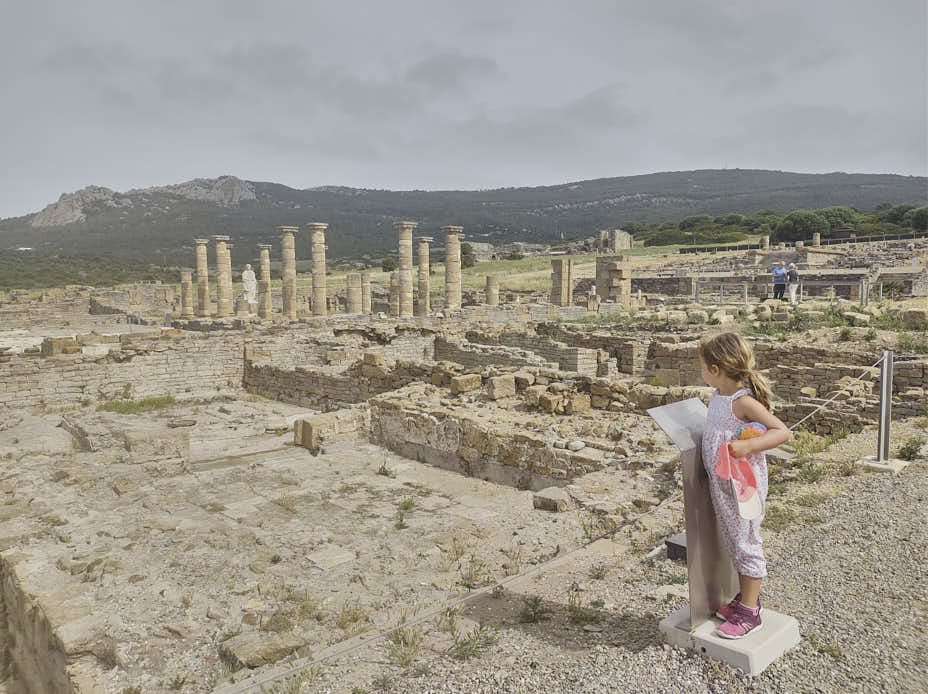
And as if that weren’t enough, Baelo Claudia sits just minutes from Tarifa, one of our favourite places in southern Spain and always a perfect excuse to extend the trip. History, nature, and the Atlantic coast come together here in a way that’s increasingly rare — and that’s exactly what makes Baelo Claudia such a memorable visit.
What is Baelo Claudia?
The Archaeological Complex of Baelo Claudia (Baelo Claudia) is a former Roman coastal city located on Bolonia Beach, in the Campo de Gibraltar area of Cádiz province. It lies just a short distance from Tarifa, at the edge of the Parque Natural del Estrecho.

The city was founded in the 2nd century BC in a highly strategic location: the Strait of Gibraltar, a key maritime corridor linking the Iberian Peninsula with North Africa. From the very beginning, Baelo Claudia’s development was closely tied to fishing, salting industries, and the production of garum, the prized Roman fish sauce that became the city’s main economic driver.

From the turn of the era, Baelo experienced significant urban growth. Its golden age came in the first half of the 2nd century AD, when the monumental forum, major public buildings, and a powerful industrial complex were constructed. It was during this period of prosperity that the settlement was granted municipal status and took on the name Claudia.

Today, Baelo Claudia is considered one of the best-preserved examples of Roman urban planning in Andalusia. Walking through the site, visitors can clearly identify the former fish-salting factories facing the sea, residential areas, cisterns, aqueducts, baths, market spaces, defensive walls, temples, and — as standout landmarks — the theatre and the basilica.

The city’s decline began in the late 2nd century AD and was accelerated by a major earthquake in the 3rd century. By around the 7th century, Baelo Claudia was completely abandoned.
In 2007, the modern institutional headquarters of the archaeological site opened, including an on-site museum with permanent and temporary exhibitions. Entry to the complex is free, and the visit offers a remarkably visual and immersive insight into daily life in a Roman city built directly beside the Atlantic Ocean — a setting that makes Baelo Claudia truly unique.
Our Visit to Baelo Claudia with Children
Walking through the ancient city of Baelo Claudia truly feels like stepping back in time. Some areas are so well preserved — and on such an impressive scale — that it’s easy to forget you’re standing beside a beach in Cádiz. At moments, it feels more like wandering through a Roman city in Italy than along the Atlantic coast of southern Spain.

We had wanted to visit Baelo Claudia for a long time. We’d heard nothing but good things, and on a couple of earlier attempts we even drove out to Bolonia, only to find the site closed. This time, we planned it properly and visited on a spring Sunday morning. It was quiet, pleasantly warm, and ideal for exploring at a relaxed pace before the midday heat set in.
The visit begins at the Visitor Centre and Museum, which we really enjoyed. The space is bright, modern, and beautifully integrated with the archaeological remains outside. It’s an excellent introduction, helping you understand the layout and significance of the city before stepping into the ruins themselves.

From there, you move into the open-air archaeological site. The enclosure is large, with a route of roughly two kilometres, but it’s easy to walk and well laid out. Even with young children, the paths are manageable, and it’s perfectly possible to visit with a pushchair — something that’s surprisingly rare at archaeological sites.
To keep the experience engaging, we turned the walk into a kind of time-travel game, imagining daily life in the Roman city: visiting the fish-salting factories, shopping at the market, heading to the theatre, or returning home through the residential quarters. It worked brilliantly — curiosity replaced boredom, and learning happened almost without effort.

Experiences like this are a good reminder that places which might initially seem “too historical” for younger visitors can become genuinely enjoyable with a little imagination. Baelo Claudia isn’t just a collection of ruins; it’s an open, coastal landscape where history feels tangible, accessible, and surprisingly easy to connect with — for adults and children alike.
Practical Information for Visiting Baelo Claudia
Tickets and Access
Entry to the Baelo Claudia Archaeological Complex is free for all visitors.
At the entrance, Spanish visitors are asked for a postcode; international visitors simply indicate their country of origin.
- Individuals and groups of fewer than 10 people do not need to book in advance. You can arrive directly during opening hours.
- Non-family groups of 10 or more people, as well as certain organised activities, must book in advance through the Andalusian Ministry of Culture and Sport’s reservation platform.
- Guided group tours are not offered by the site itself.
⏰ Last entry is permitted up to 30 minutes before closing time.
Opening Hours
Baelo Claudia is open almost all year round, but hours vary by season. It’s always worth double-checking the official site before you go, especially on public holidays.
21 March – 20 June
- Tuesday to Saturday: 9:00 – 21:00
- Sundays, public holidays & holiday eves: 9:00 – 15:00
- Monday: closed (except holiday eves)
21 June – 20 September
- Tuesday to Saturday: 9:00 – 15:00
- Sundays, public holidays & holiday eves: 9:00 – 15:00
- Monday: closed (except holiday eves)
21 September – 20 March
- Tuesday to Saturday: 9:00 – 18:00
- Sundays, public holidays & holiday eves: 9:00 – 15:00
- Monday: closed (except holiday eves)
💡 Tip: In summer, visit early in the morning. Temperatures are cooler, the site is quieter, and the experience is far more enjoyable.

How to Get There
Baelo Claudia is located on Bolonia Beach, within the municipality of Tarifa, on Cádiz’s Atlantic coast.
- By car: The easiest option, especially if travelling with children. From Tarifa, it’s about a 20-minute drive via the CA-8202 towards Bolonia. The site is well signposted.
- From Cádiz or the Costa de la Luz: Follow the N-340 and turn off towards Bolonia after passing Tarifa.
- Public transport: There are seasonal buses to Bolonia Beach, but services are limited. For flexibility, a car is strongly recommended.
📍 GPS address: Ensenada de Bolonia s/n, 11380 Tarifa (Cádiz)
💡 Travel tip: The drive itself is part of the experience. Once there, it’s easy to combine the visit with Bolonia Beach, the sand dune, or time in Tarifa.
Parking
A large free car park is located right at the entrance to the archaeological site. It’s usually easy to find space, and the bays are generous—suitable for campervans and motorhomes as well.
Practical Tips for Your Visit
- Always check opening hours in advance to avoid disappointment—we’ve arrived to find it closed before.
- In summer, plan for early morning or late afternoon, bring sun protection, water, and snacks.
- Shaded picnic tables are available at the entrance, ideal for a relaxed meal before or after your visit.
- Allow extra time to explore the surroundings: Bolonia Beach, the dune system, Tarifa town, or nearby Atlantic beaches are all worth it.
Official Website
For up-to-date information, downloadable materials, and official route suggestions, visit the official Baelo Claudia website. You’ll also find a helpful visitor leaflet in English with a recommended walking route and clear explanations to help you understand the site as you explore.
Final Thoughts
After exploring this extraordinary Roman city, chances are you’ll be ready to slow things down. A swim at Bolonia Beach, or a gentle walk to the towering sand dune behind the ruins, is the perfect way to round off the visit. And if you still have energy to spare, heading into Tarifa for a plate of locally caught tuna is always a winning plan.

Baelo Claudia is one of those rare places that truly has it all: history, nature, dramatic scenery, and a setting that works just as well for couples, friends, or families. It’s an essential stop on any journey along the Cádiz coast—and one that leaves a lasting impression.
If this visit has whetted your appetite for more Andalusian discoveries, you might enjoy exploring some of the other remarkable corners of the region. Very close by, Gibraltar offers a completely different experience and can easily be visited in a single day.
FAQ
Where is Baelo Claudia located?
Baelo Claudia is on Bolonia Beach, near Tarifa, in the province of Cádiz. It sits right on the Atlantic coast, within a protected natural setting.
Is Baelo Claudia free to visit?
Yes. Entry to the archaeological site and museum is completely free for all visitors.
Is Baelo Claudia suitable for children?
Absolutely. The site is open, spacious, and easy to explore. With a bit of imagination, it’s a fantastic way for children to learn about Roman life—plus the beach right next door is a big bonus.
Do I need to book tickets in advance?
No booking is required for individual visitors or small family groups. Reservations are only needed for non-family groups of 10 or more people.
Is parking available?
Yes. There’s a large free car park right at the entrance, suitable for cars, campervans, and motorhomes.
How long does a visit take?
Plan around 1.5 to 2 hours for the ruins and museum. Many visitors combine it with time at the beach or the Bolonia dune.
About the Authors:
This article was written by Lucía and Mike, the couple behind Andalusia Uncovered and the creators of Bloguera Viajera, one of Andalusia’s leading family travel websites, where we have spent years sharing our experiences exploring Spain and beyond.
Andalusia Uncovered grew from a simple idea: to create an English-language resource based on real experiences, not recycled travel advice. Every place we write about is somewhere we have personally visited, photographed and explored ourselves.
Lucía grew up in Spain and Mike moved here from England in 2010. Together, we have spent years discovering Andalusia’s cities, white villages, beaches, mountains and lesser-known corners, often with our two daughters in tow.
In a world increasingly filled with generic AI-generated content, we believe first-hand experience matters more than ever. Our aim is to provide honest recommendations, practical advice and genuine local insight to help you discover the real Andalusia for yourself.