
At first glance, Padul looks like a typical town in the Lecrín Valley. It isn’t until you start exploring that you realise how unusual this landscape really is. For thousands of years, much of the area was covered by a vast lake. The wetlands that remain today are home to one of the most important palaeontological discoveries in Andalusia: the remains of a mammoth and its calf, found here in 1982.
We first visited Padul to walk the Mammoth Trail and left feeling we’d only scratched the surface. On our second visit, we spent the weekend exploring the wetlands, walking some of the prehistoric-themed trails, visiting the old grain silo and learning more about the history of the valley.

Its an easy day trip from Granada, and somewhere to spend a relaxing weekend combining nature, walking and local history.
Contents
Where is Padul?
Padul is in the Lecrín Valley, around 20 minutes south of Granada city and roughly halfway between Granada and the Costa Tropical. It’s just off the A-44 motorway, so it’s easy to include if you’re travelling between Granada and the coast.
The town sits at the western edge of the Sierra Nevada Natural Park, with the Padul wetlands immediately beside it and the mountains rising behind. Its rural area where agriculture takes advantage of these fertile soils.
Hiking in Padul and the wetlands
The wetlands are probably the best place to start exploring Padul. There are three main marked trails, all named after prehistoric animals: the Mammoth Trail, Woolly Rhinoceros Trail and Sabre-Toothed Tiger Trail.
We’ve walked the Mammoth Trail twice and it’s the route we’d recommend if this is your first visit. At 8.3 km, it’s the shortest of the three and completely flat, with sections on wooden boardwalks through the wetlands.
The other two routes extend the walk into the surrounding landscape. The Woolly Rhinoceros Trail includes the old Iberian-Roman road and the Manantial del Mal Nombre spring, while the Sabre-Toothed Tiger Trail is the longest option at around 10 km.
All three are straightforward walks rather than difficult mountain hikes, so your choice mainly comes down to how far you want to walk and what else you want to see along the way.
The Mammoth Trail (Ruta del Mamut)
The Mammoth Trail is Padul’s best-known walk and the one we’ve now done a couple of times. The route starts near the prehistoric animal figures and the El Aguadero Nature Centre.
Distance: 8.3 km
Time: Allow at least 2 hours
Elevation: Virtually flat
Difficulty: Easy
Terrain: Paths and wooden boardwalks around the wetland

The boardwalk sections make this a particularly enjoyable route, taking you through the reeds and close to the wetland rather than simply walking around its edge. There are also birdwatching points along the way, so bring binoculars if you have them.
There are picnic tables near the start of the route. We’ve found taking a picnic works particularly well here, especially when walking with children, as you can stop before or after the walk rather than having to head straight back into town.
The Woolly Rhinoceros Trail (Sendero del Rinoceronte Lanudo)
The Woolly Rhinoceros Trail extends the walk beyond the Mammoth Trail and is a good option if you want to see a little more of the area.
One of the main reasons to choose this route is that it passes along the old Iberian-Roman road, where you can still see grooves in the stone left by carts travelling between Granada and Almuñécar. At the time, the lake covered much more of the valley, making this an important route towards the coast.

The trail also passes the Manantial del Mal Nombre spring and has open views across the wetlands towards Sierra Nevada.
Distance: 9.2 km
Time: Around 2½ hours
Elevation: Low
Difficulty: Easy to moderate, mainly because of the distance
It’s only slightly longer than the Mammoth Trail, so if you have the time, we’d choose this one if you’re particularly interested in seeing the old road as part of your walk.
The Sabre-Toothed Tiger Trail (Tigre Dientes de Sable)
The Sabre-Toothed Tiger Trail is the longest of Padul’s three prehistoric-themed routes, at around 10 km. It shares some sections with the other trails before extending further into the surrounding countryside.
There’s nothing particularly technical about the walk, but the extra distance and gradual elevation make it a little more demanding than the Mammoth Trail.

Distance: 10 km
Time: Around 2½ hours
Elevation: Moderate and gradual
Difficulty: Moderate, mainly because of the length
If you’re comfortable walking 10 km, it’s a good option for spending a full morning exploring the area rather than sticking to the shorter circuit.
El Aguadero Nature Centre (Aula de Naturaleza El Aguadero)
Right at the start of the trails, next to the prehistoric animal figures, you’ll find the El Aguadero Nature Centre. It’s worth visiting before you set off to learn about the geography of the area and it´s history.
Outside, there’s a shaded area with picnic tables and a small children’s playground. The playground itself is fairly basic and could do with some maintenance, but it’s a useful place to stop if you’re visiting with younger children.
There’s also parking beside the centre. It can fill up on busy weekends, but there’s alternative parking near Restaurante Montesol, with a path that connects directly to the walking routes.
Opening hours: At the time of our visit, the centre was open Saturdays and Sundays from 10:00 to 14:00. Check the current opening hours before travelling, as they may change.
The Padul Wetlands and Peat Bogs
The Padul wetlands cover around 300 hectares and form part of the Sierra Nevada Natural Park. They’re also protected as a Special Protection Area for Birds (ZEPA) and recognised as a Wetland of International Importance.
Today, much of the landscape is covered by reeds and wetland vegetation, with numerous species of birds using the area throughout the year. There are several observation points along the trails, so binoculars are worth bringing. We didn’t have much luck birdwatching with two noisy children in tow, but that’s more a reflection on us than the wetlands.
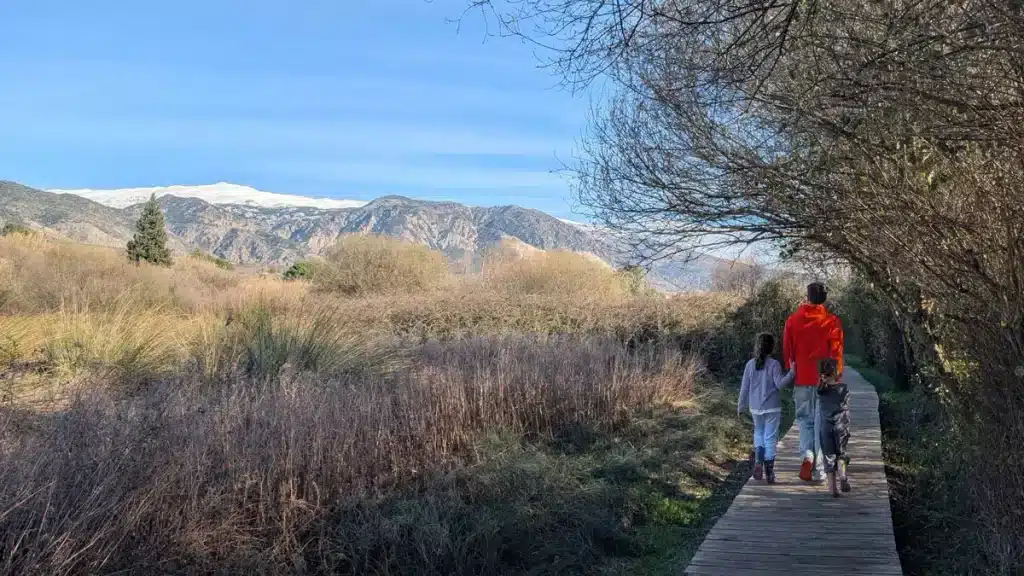
The peat bogs are particularly important. It was these conditions that helped preserve the prehistoric remains found here, and they’re one of the features that make Padul unusual within Granada province.
The terrain around the wetlands is mostly flat, so you don’t necessarily need to complete one of the full marked routes. If you’re short on time, you can simply walk part of the boardwalks and turn back.
If you’re visiting in spring or summer, bring insect repellent. And if the weather is good, the picnic area near the Nature Centre is an easy place to stop for lunch before or after your walk.
Exploring Padul Town Centre
The wetlands are the main reason many people visit Padul, but it’s worth allowing some time to explore the town centre as well. Several of the places connected to Padul’s history are within easy walking distance of each other, so you don’t need long to see them.
The Mammoth and Calf
You can’t really miss the enormous mammoth and calf sculptures in the centre of Padul. They have become something of a symbol of the town, and once you start looking, you’ll notice mammoths everywhere, from the tourist office and local businesses to the school.

The Old Railway Station and Tourist Office
Close to the mammoth sculptures, Padul’s former railway station has been restored and converted into the tourist office. We particularly liked the restoration of the old station and the Monument to the Emigrant on the platform, which describes an emigrant as “a traveller towards uncertainty”.
It’s a useful first stop if you want maps of the walking trails or information about other places to visit in the Lecrín Valley.

Opening hours: When we visited, the tourist office was open Friday and Saturday from 10:00 to 12:00 and 16:00 to 18:00, and Sunday from 11:00 to 14:00. Check the current opening hours before visiting.
The Padul Silo
The Silo was one of the biggest surprises of our second visit to Padul. It only opened to visitors recently and, having visited several old grain silos around Spain, this has been our favourite so far.

The building originally contained 15 grain cells, each 21 metres high. What makes the visit particularly interesting is that you can actually step inside some of them, which gives you a much better idea of how the silo worked than simply looking at displays.
There’s also a small ethnographic museum and a short video showing how grain was handled inside the building. Other footage shows traditional agricultural work and helps put some of the tools in the museum into context. We found this particularly useful for the children, who could see what the equipment was actually used for.

You can then climb more than 100 steps to the top of the silo. From here, you get excellent views across Padul, the surrounding countryside and towards Sierra Nevada. We visited in February, when the mountains were covered in snow, which made the climb particularly worthwhile.
Entrance: Free
Opening hours: At the time of our visit, Sundays from 12:00 to 14:00 only.
If you want to visit the Silo, it’s worth planning your day around these limited opening hours and check the times with the tourist office.

Before leaving, walk around the outside of the building. Each side has a different mural by Granada street artist El Niño de las Pinturas, with the artwork referencing Padul’s culture, traditions and agricultural roots.
The Old Wash House and Fuente de los Cinco Caños
Tucked away among the streets of Padul, the old public wash house is quite easy to miss. In fact, we probably wouldn’t have found it if Irene from Al-Agia hadn’t told us about it.
The rectangular brick building sits in a small square and is surprisingly attractive for such a functional structure. We visited around sunset, when the light coming through the building was particularly nice.

Inside, a sculpture of a washerwoman pays tribute to the generations of local women who used places like this to wash clothes by hand. At one end, you can also see a small water cistern, another reminder of how closely Padul’s history has been connected to water.
The nearby Fuente de los Cinco Caños, or Five-Spout Fountain, can easily be included while walking around this part of town.
The Iberian-Roman Road and Manantial del Mal Nombre
Near where we stayed in Padul is a surviving section of the old Iberian-Roman road that once formed part of the route between Granada and Almuñécar.
You can still clearly see grooves worn into the stone by the carts that travelled along it. When the lake occupied much more of the valley, this route provided an important connection between Granada and the coast.
Some of Padul’s walking trails pass this way, but you can also reach the area by car if you don’t want to complete the full route.
Right beside the old road is the Manantial del Mal Nombre, which translates rather innocently as the “Spring with a Bad Name”. The story behind it is considerably less innocent. Its original popular name was apparently Manantial del Coño, supposedly because people arriving here would see the amount of water coming from the spring and exclaim: “¡Coño, cuánta agua hay aquí!” I´ll leave you to figure out the meaning of that one.
Where to Eat in Padul
We tried several places during our weekend in Padul, from a proper dinner at Mammut Gastroespacio to pizza delivered to our accommodation and a final tapas lunch before driving back to Málaga.
Mamut Gastroespacio
We’d already spotted Mamut Gastroespacio after our first visit to Padul because of its excellent reviews, so this time we booked a table for dinner.
The menu mixes more traditional dishes with Asian and Mexican influences, alongside burgers and grilled meats. You might find bao buns filled with shredded beef rib, teriyaki sauce, Parmesan and mango mustard alongside matured beef burgers or grilled octopus.

We wanted to order far too much when we first looked at the menu, but fortunately stuck to roughly one dish each. The portions are generous.
The restaurant itself is modern and informal, and it was very busy when we visited. Despite that, the service was friendly and we never felt forgotten.
If we return to Padul, this is somewhere we’d happily eat again, partly because there were several things on the menu we didn’t get around to trying.
Other Places to Eat in Padul
The following evening we decided to make the most of our rural house and its fireplace, so we ordered pizzas from Pizzeria Takeaway Padul. They delivered directly to Al-Agia, the pizzas were good and the prices were reasonable.
On our final day, we wanted to have some tapas before driving back to Málaga and ended up at Garden Gastrobar. We were lucky with the weather and ate outside on the terrace.
We’d also planned to try La Flota, a small restaurant specialising in fried fish, but even though we arrived fairly early, there wasn’t a table available.
So that’s already our food plan for the next visit: finally try La Flota and return to Mammut Gastroespacio for some of the dishes we didn’t manage the first time.
Where to Stay in Padul
One of the reasons we returned to Padul was Al-Agia, a collection of converted watermills just outside the town.
Al-Agia Rural Accommodation
The lower part has four restored mills surrounded by gardens, with swimming pools, an irrigation channel and plenty of ducks, which were a big hit with our girls. Our house had a full kitchen and fireplace, making it a comfortable base for a weekend.

Higher up are two properties called Los Miradores. They don’t have pools, but the views are the real reason to stay here. From the main bedroom of one, you can look across the Lecrín Valley towards the Padul wetlands and Sierra Nevada without getting out of bed.

Irene from Al-Agia also offers guided visits of Padul. Her local knowledge helped us discover several places we would probably have missed on our own.
Here´s the link to book the accomadation.
Practical Information for Visiting Padul
Getting there
Padul is around 20 minutes by car from Granada, just off the A-44 towards the Costa Tropical. Having a car is the easiest option, particularly if you want to explore other parts of the Lecrín Valley.
How long do you need?
You can easily visit Padul as a day trip. Allow a morning for one of the wetland trails, followed by lunch and a walk around the town centre.
If you want to explore more of the Lecrín Valley or combine Padul with Granada, its best to stay a night.
Best time to visit
Spring and autumn are the most comfortable seasons for walking. Summer temperatures can be high, particularly during the middle of the day, so we’d start the trails early.
Winter can also be a good time to visit. We were here in February and had clear views of snow-covered Sierra Nevada from Padul.
Frequently Asked Questions About Padul
Where are the Padul mammoth remains?
The original mammoth remains discovered in Padul are displayed at the Parque de las Ciencias in Granada. In Padul itself, you can visit the area where they were found and learn more at the El Aguadero Nature Centre.
How long is the Mammoth Trail in Padul?
The Mammoth Trail is approximately 8.3 km and almost completely flat. Allow at least two hours to complete it.
Can you see the ancient cart tracks in Padul?
Yes. Grooves left by carts are still visible on the old Iberian-Roman road that once formed part of the route between Granada and Almuñécar.
Is Padul good for families?
Yes. We’ve visited with our children several times. The flat wetland trails are particularly accessible for families, and the mammoth theme gives children something to look out for as they explore.
If Padul’s prehistoric landscape interests you, another part of Granada province we’d highly recommend is the Granada Geopark. We’ve spent quite a bit of time exploring the area, with its badlands, caves, archaeological sites and some of the most unusual landscapes in Andalusia.
Read our guide to the Granada Geopark to start planning your visit.